
Treating a Watery Nose (Rhinorrhea): Why Targeted Nerve Surgery Is Changing Practice
A persistently watery nose—rhinorrhea—is one of the most common yet poorly understood symptoms we see in rhinology. Patients often arrive having been treated repeatedly for “allergies” or “sinus problems,” yet their dominant complaint remains unchanged: a constant need for tissues, social embarrassment, and a sense that their nose is never dry. Although, we all might suffer a watery nose when skiing, going for a jog on an early morning or from eating spicy foods, this can be a daily occurence for those patients with a neurogenic rhinitis.
For clinicians, the challenge is that rhinorrhea is not a diagnosis—it is a physiological output. The underlying driver, in many patients, is not inflammation alone but neurogenic dysregulation of nasal secretion, particularly in non-allergic, neurogenic or mixed rhinitis. Nasal hyper-reactivity is the contemporary term. This distinction explains why conventional therapies frequently fail—and why surgery, when appropriately selected, can be transformative.
From Vidian Neurectomy to Targeted Nasal Denervation
Historically, vidian neurectomy was the definitive surgical solution for refractory rhinorrhea. By interrupting parasympathetic input at the level of the vidian nerve, the procedure reduces glandular secretion across the nasal mucosa. A systematic review demonstrated consistent improvement in rhinorrhea across studies (1). Gustatory rhinitis was the classic condition cured by vidain neurectomy. We use to see it commonly after bariatric surgery.
While dry eye is commonly reported, it is usually temporary, resolving over time. However, the small risk of persistent symptoms must be balanced against the fact that rhinorrhea is a benign, non-progressive condition, which has driven a shift toward more targeted interventions (1).
The Rationale for Posterior Nasal Nerve (PNN) Surgery
Modern surgical management focuses on the posterior nasal nerve (PNN), a distal parasympathetic pathway supplying the nasal mucosa. Rather than interrupting the system proximally, PNN surgery targets secretion at its effector site.
Anatomical work shows that autonomic fibres are distributed across multiple nasal nerve branches, supporting the need for targeted but adequate denervation (2).
Clinically, PNN offers:
- effective reduction in rhinorrhea
- preservation of lacrimal function
- lower morbidity than vidian neurectomy
Identifying the Right Patient
Successful outcomes depend on selecting the right patient.
Typical features include:
- persistent clear, watery rhinorrhea
- poor response to intranasal steroids and antihistamines
- non-allergic or mixed rhinitis phenotype
These patients often describe triggers such as cold air, eating, or environmental irritants, and frequently report postnasal drip and cough.When it co-exists with allergy, immunotherapy is almost alwasy done first as most nasal hyperactivity disappears when the allergic component is treated.
Prognostication: The Role of Ipratropium
A trial of intranasal ipratropium bromide is one of the most useful tools in clinic.

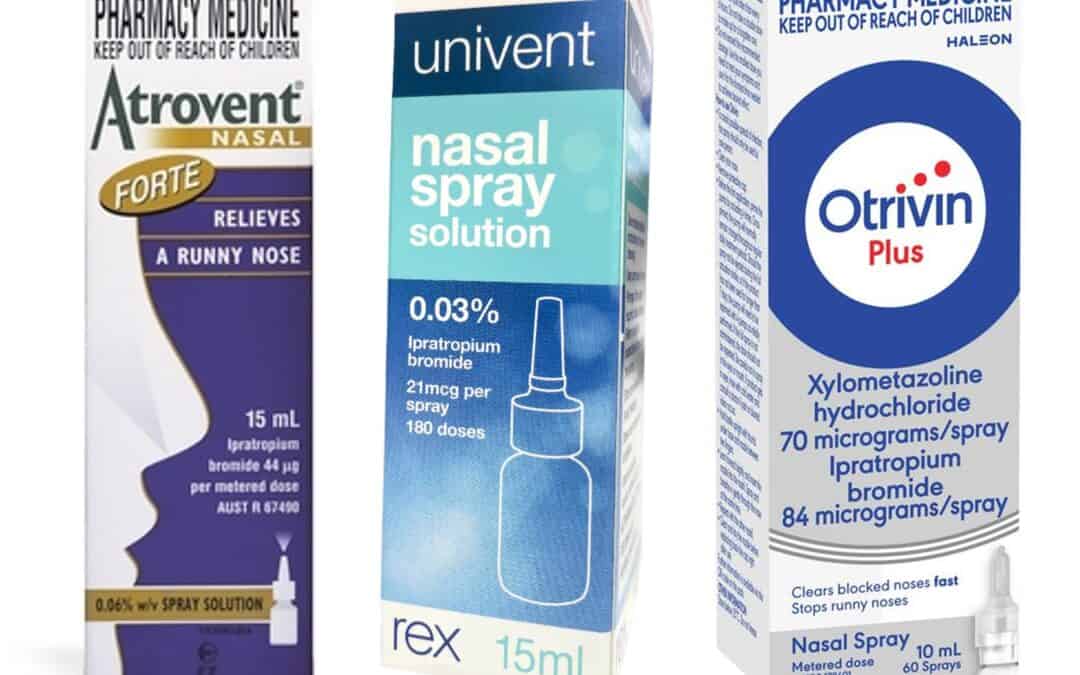
Nasal iaptropium is no longer sold as “Nasal” atrovent but can be compounded or found in other forms locally and in NZ
A positive response indicates parasympathetic-driven secretion, helping predict response to intervention. Studies show that ipratropium responsiveness predicts outcomes in PNN ablation procedures, although surgical PNN remains effective even in non-responders (3).
The Rise—and Limits—of In-Office Ablation
Cryotherapy and radiofrequency ablation of the PNN have gained popularity as office-based procedures.
Short-term results are encouraging, with 70–80% of patients improving (4). However, durability remains the key limitation.
A multicentre study showed:
- 84% initial improvement
- ~95% recurrence over time
- mean recurrence at ~5 months (4)
This reflects partial nerve injury rather than definitive transection.
Patients should therefore understand:
- benefit is often temporary
- repeat procedures may be required
Morbidity and Patient Experience
Although marketed as minimally invasive, these procedures are not trivial.
Patients frequently report:
- significant discomfort under local anaesthesia
- post-procedural pain and crusting
- occasional epistaxis requiring intervention (5)
In the Australian context, this raises practical considerations. Many patients prefer a single definitive day surgery procedure, rather than repeated uncomfortable outpatient treatments.
Why Surgical PNN Remains My Preferred Approach
In my practice, I favour endoscopic posterior nasal nerve neurectomy.
The advantages are clear:
- Durability: true nerve division reduces recurrence
- Low morbidity: avoids lacrimal complications
- Efficiency: single day procedure
- Reliability: less dependent on pre-selection
The Septal Swell Body: The Missing Piece in Rhinorrhea Surgery
John Craig and i discusssed one of the most overlooked contributors to persistent rhinorrhea is the septal swell body (SSB).
Often dismissed as a minor septal thickening, it is in fact a distinct functional structure.
Histologically, the SSB contains dense seromucinous glands—up to 50% glandular tissue, significantly greater than surrounding septum (6). It also demonstrates specialised architecture and vascularity, distinguishing it from typical septal mucosa (7).
Functionally, the SSB behaves dynamically. Imaging studies show that its size varies with turbinate changes, suggesting a role in nasal cycling (8). Physiological studies further demonstrate that targeted decongestion improves airflow, comparable to turbinate decongestion (9).
This has direct relevance to rhinorrhea.
The SSB is:
- a glandular structure contributing to secretion
- a vasoactive region influencing airflow
- likely involved in neurogenic reflex pathways
Importantly, parasympathetic fibres are not confined to the PNN. John’s own research show that autonomic input also arises from other pathways, including the anterior ethmoid nerve (2).
This raises an important point:
PNN surgery alone may not fully address all sources of nasal secretion
The SSB may represent a residual driver of rhinorrhea, particularly in patients with incomplete response.
A Practical Surgical Strategy
As no practical way to selectively perform an Anterior Ethmoid Neurectomy has been described, there has been growing interest in treating the SSB using radiofrequency techniques, with studies demonstrating significant symptom improvement (10). However, these approaches add cost and risk thermal injury.
In my practice, I favour a simple mechanical reduction:
- endoscopic shaving of the SSB
- no thermal injury
- low cost and reproducible
This integrates naturally with:
- PNN neurectomy
- turbinate surgery
A critical technical point is that the area heals by secondary intention. To prevent desiccation and optimise healing, I routinely use a:
👉 0.5 mm silicone (silastic) sheet
to protect the mucosa during recovery.
Moving Toward Precision Rhinology
Rhinorrhea is not a single-site disease. It is a distributed physiological process involving:
- neural pathways
- glandular tissue
- vascular structures
Treatment should reflect this.
We now have a spectrum:
- medical therapy
- ipratropium (diagnostic + therapeutic)
- ablation (selected patients)
- PNN surgery (durable neural control)
- SSB reduction (glandular + anterior contribution)
Conclusion
The management of a watery nose has evolved from broad autonomic interruption to precision, physiology-driven surgery.
While newer technologies offer convenience, their limitations—particularly durability—must be acknowledged.
For many patients, the goal is not temporary relief but long-term control with minimal morbidity.
Combining posterior nasal nerve surgery with targeted treatment of the septal swell body represents a more complete and modern approach to rhinorrhea.
- Marshak T, Yun WK, Hazout C, Sacks R, Harvey RJ. A systematic review of the evidence base for vidian neurectomy in managing rhinitis. J Laryngol Otol. 2016;130(S4):S7–S28.
- Craig JR, Dunn RT, Ray A, Keller CE, Peterson EL, Eide JG. Cadaveric analysis of autonomic nerve fiber density in posterior nasal, posterolateral nasal, and anterior ethmoid nerves. Int Forum Allergy Rhinol. 2023;13(11):2109–2112.
- Maddineni S, Hwang PH, Ayoub NF, Patel ZM, Nayak JV, Chang MT. Predictive value of ipratropium responsiveness on posterior nasal nerve neurectomy outcomes in chronic rhinitis. Otolaryngol Head Neck Surg. 2026;174(2):359–365.
- Craig JR, Mack C, Vidovich A, Wilson C, Nguyen TV, Kuan EC. Rhinorrhea recurrence after posterior nasal nerve cryoablation: a multicenter cohort study. Laryngoscope. 2025;135:1928–1934.
- Lin CC, Hwang YL, Liao JY, Teng HL, Shih TY, Huang CY. Radiofrequency ablation versus laser neurolysis of the posterior nasal nerve in patients with chronic rhinitis. Otolaryngol Head Neck Surg. 2026;174(4):954–962.
- Wexler D, Braverman I, Amar M. Histology of the nasal septal swell body. Otolaryngol Head Neck Surg. 2006;134:596–600.
- Şişman AS, Acıoğlu E, Yiğit Ö, et al. Nasal septal turbinate: cadaveric study. Am J Rhinol Allergy. 2014;28:e173–e177.
- Wong EH, Noussair M, Hasan Z, et al. Physiological changes in septal swell body size correlate with inferior turbinate changes. J Laryngol Otol. 2020;134:323–327.
- Wong EH, Deboever N, Chong J, et al. Isolated topical decongestion of the septal swell body improves nasal airflow. Am J Rhinol Allergy. 2020;34:417–421.
- Pritikin J, Silvers S, Rosenbloom J, et al. Temperature-controlled radiofrequency treatment of the septal swell body: 12-month outcomes. Int Forum Allergy Rhinol. 2024;14:1549–1557.
What causes a constantly runny nose?
A persistent watery nose is often caused by overactive nerve signals (non-allergic rhinitis), not just allergies or infection.
What is posterior nasal nerve (PNN) surgery?
PNN surgery is a procedure that reduces nasal secretion by interrupting parasympathetic nerve signals to the nasal lining.
Why might PNN surgery not fully stop rhinorrhea?
Other areas, such as the septal swell body, may continue to produce mucus due to additional nerve pathways.
What is the septal swell body?
It is a gland-rich area of the nasal septum that contributes to nasal airflow and mucus production.
Is surgery better than in-office treatments?
Surgery is often more durable, while in-office treatments like cryotherapy may provide temporary relief.